
The Log That Started Everything
There are craftsmen who decide to work with wood. And then there are craftsmen the wood decides to work with.
Common Moyo is the second kind.
He grew up in Zimbabwe, the youngest of three brothers. One afternoon — he could not have been more than a boy — he and his siblings were walking through an open field when something stopped them. A log. Lying in the grass, weathered and rough, it had taken a shape that all three boys recognised immediately.
It looked like a crocodile.
They picked it up. They took it home. And with whatever tools they had, they began to fine-tune what they had already seen — not inventing a shape, but revealing the one that was already there.
When they took it to the market, it sold on the first day. The money was good. Better than good.
They never looked back.
What a log started, a family built
Word travels fast in a family when something works. It did not take long before the Moyo household became a workshop — brothers sitting together, each working on his own piece, each one watching the others, correcting, refining, debating. The standard they set for each other was simple and absolute. The final product had to be pristine.
That collective discipline produced three different expressions of the same gift.
The eldest brother went on to become a renowned producer of wooden craft — his work recognised and sought after at scale. The middle brother found his calling in trade, reading the market the way Common reads wood. He operates out of Cape Town now, placing African craft in homes and spaces across the Western Cape.
And Common — the youngest — went the most particular path of all.
He works only on pieces that are one of one.
The man who sees what others cannot
Ask Common Moyo to describe his process and he will tell you something that sounds simple until you think about it.
He picks up a piece of raw wood. He looks at it. And he can already tell you what sculpture is inside it.
Not what he will make. What is already there.
His hands follow the wood's intention. The grain, the knots, the curves that years of growth have already decided — Common reads all of it before he makes a single cut. He is not imposing a design. He is finding one.
This is why he does not make replicas. Not because he cannot — he is technically capable of extraordinary precision. But because every piece of wood has its own singular truth. To copy it would be to lie about what the material is.
What Common Moyo makes cannot be mass-produced. It cannot be sourced from a catalogue. It cannot be replicated by a factory in any country on earth.
It exists once. Then it belongs to whoever was paying attention.
What you see in the photograph
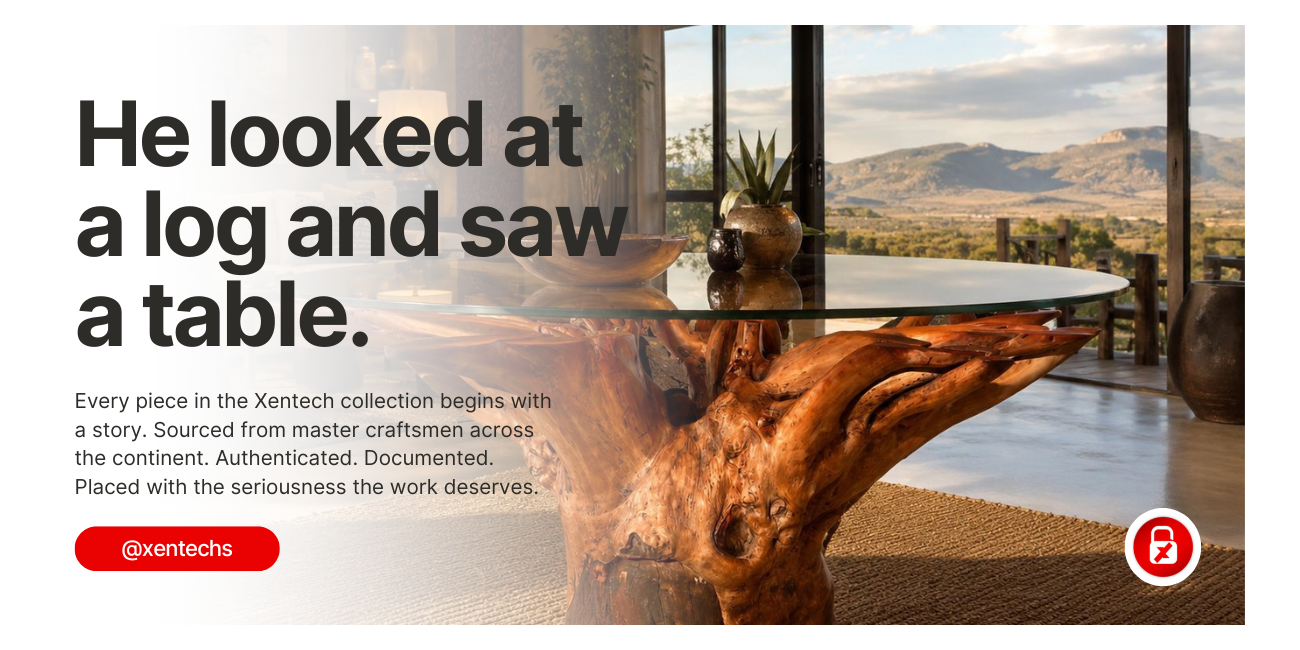
The table in this image began as a root system. Something that spent decades underground, holding a tree in place, invisible and essential.
Common saw a table in it.
What he did not change — could not change, would not change — is the organic chaos of the root's natural form. The twisting branches of wood that splay outward to hold the glass surface are not carved to look wild. They are wild. They were always wild. Common simply gave them a purpose that the world above ground could see.
The glass top sits on top of all of that history as lightly as light sits on water.
It is the most honest piece of furniture you will ever own. It does not pretend to be anything other than what the earth made and one man saw.
Why Xentech carries Common Moyo's work
Xentech exists to preserve African culture by making it economically irresistible. Common Moyo's story is precisely the kind of cultural intelligence that we are built to carry and protect.
His gift did not come from a design school. It came from a field in Zimbabwe, a log that looked like a crocodile, and three brothers who understood that what they had found was worth something.
The global market is full of African-inspired design. Xentech carries African design — the real thing, made by real hands, with a story that can be verified, documented, and told with pride in any boardroom, any lodge, any home on any continent.
Common Moyo is available for commissions and bespoke pieces through Xentech. Every piece he makes comes with full provenance documentation — maker profile, origin story, and certification of authenticity.
There is only one Common Moyo. And there is only one of each thing he makes.
Why Xentech carries Common Moyo's work
Xentech exists to preserve African culture by making it economically irresistible. Common Moyo's story is precisely the kind of cultural intelligence that we are built to carry and protect.
His gift did not come from a design school. It came from a field in Zimbabwe, a log that looked like a crocodile, and three brothers who understood that what they had found was worth something.
The global market is full of African-inspired design. Xentech carries African design — the real thing, made by real hands, with a story that can be verified, documented, and told with pride in any boardroom, any lodge, any home on any continent.
Common Moyo is available for commissions and bespoke pieces through Xentech. Every piece he makes comes with full provenance documentation — maker profile, origin story, and certification of authenticity.
There is only one Common Moyo. And there is only one of each thing he makes.
Recent Posts


Welcoming Our First Artisan Seller to Xentechs: Handcrafted Creations from Hartbeespoort


From Expensive Ads to Smart Influencers: Discover Cost-Effective Marketing Strategies Today!



Reigniting Africa’s Industrial Growth: Pathways to Becoming a First-World Continent

Xentechs

At Xentechs, we believe that every individual in Africa should have the opportunity to shop with ease, diversity, and reliability. Our platform is more than just an online shopping destination; it is a vibrant community that celebrates the rich, cultural tapestry of Africa, one shop at a time. We aim to connect Africa by bridging the gap between local sellers and global consumers, making shopping in Africa an accessible and exciting experience.


